R&D Roadmap & Market Forecasting Technological Architecture & Future Sourcing Trends in Open-Ear OWS Audio (2026–2030)
1. Directional Sound Field Synthesis and Acoustic Leakage Suppression
The fundamental engineering bottleneck in open-ear audio design is controlling unconfined sound dispersion. Standard open speakers radiate acoustic energy in a spherical pattern, leading to significant sound spill that compromises user privacy in quiet office settings, transit vehicles, or elevators. Pebble’s R&D team addresses this challenge through advanced Directional Sound Field Synthesis.
By placing secondary acoustic ventilation ports at precise geometric offset angles relative to the primary speaker diaphragm, the earbud generates inverted acoustic phase signals. When outward sound waves exit the housing, they encounter these inverse-phase signals, resulting in destructive interference that cancels up to 28dB of leaked acoustic energy. For enterprise clients, offering OWS products equipped with verified privacy-protection algorithms eliminates a major barrier to consumer adoption.
2. Overcoming Low-Frequency Roll-Off via Large-Format Bio-Composite Diaphragms
Physics dictates that sound pressure level (SPL) drops precipitously in open-air conditions as frequencies decrease below 200Hz. Traditional in-ear earbuds rely on sealing the ear canal to create a closed acoustic chamber capable of sustaining deep sub-bass frequencies. Open-ear architectures, operating without a ear-canal seal, traditionally suffer from thin, tinny audio reproduction.
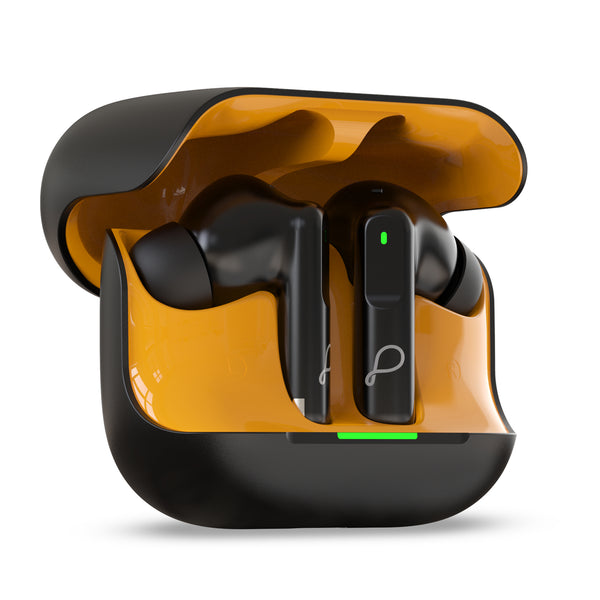
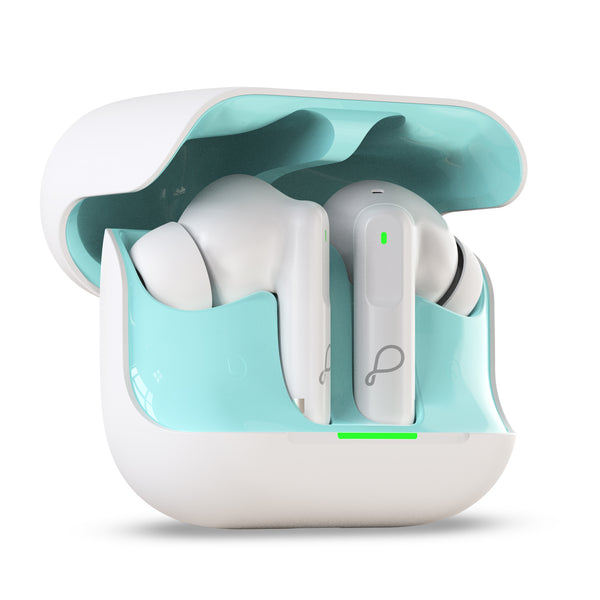
To compensate for bass pressure loss, Pebble integrates oversized 14.2mm to 16.2mm biological composite diaphragms within the Open Loop OWS series. Constructed from lightweight plant fibers reinforced with a ultra-thin polyurethane (PU) suspension edge, these drivers deliver larger volumetric air displacement per displacement stroke. Controlled by a dedicated 32-bit digital signal processor (DSP) loaded with Pebble’s dynamic bass enhancement algorithm, our OWS earbuds maintain a rich, resonant low-end frequency spectrum down to 60Hz without muddying mid-range vocal clarity.
3. Biocompatible Ergonomics & Micro-Pressure Distribution
Unlike standard TWS earbuds that rely on friction against the ear canal walls—causing soreness, moisture trapping, and bacterial infection risks after extended wear—OWS earbuds distribute hardware mass around the outer pinna. The mechanical challenge shifts from insertion friction to ear-hook clamping force optimization.
Pebble employs high-precision finite element analysis (FEA) to engineer ear-hooks containing flexible titanium nickel (NiTi) shape-memory alloy cores encased in medical-grade, hypoallergenic liquid silicone rubber (LSR). This composite structure achieves an optimal clamping pressure of under 0.15 Newtons, self-adjusting to diverse human ear geometries without localized pressure points. This ergonomic breakthrough extends daily wear duration from a typical 2-hour TWS limit to 8+ hours of uninterrupted continuous use—making OWS the ultimate audio form-factor for remote workforces, sports enthusiasts, and industrial personnel.
4. Bluetooth 5.4 LE Audio & Next-Gen Codec Integration
Future-proofing procurement catalogs requires adopting the latest Bluetooth communications protocols. Pebble’s 2026 Open-Ear OWS roadmap incorporates Bluetooth 5.4 Low Energy (LE) Audio silicon, unlocking the LC3 (Low Complexity Communication Codec) architecture. LC3 provides superior audio fidelity at half the bitrate of legacy SBC codecs, drastically lowering chip power consumption and enabling single-charge playback figures exceeding 8.5 continuous hours.
Furthermore, Bluetooth 5.4 facilitates multi-point device switching, sub-40ms audio-video synchronization for gaming/media applications, and native broadcast audio support (Auracast™), positioning Pebble OWS units at the absolute cutting edge of wireless connectivity.