
HD Camera Smart Glasses Sourcing Architecture: Engineering Benchmarks, Intent Analysis, and Global Market Expansion for B2B Buyers
The global wearable technology ecosystem is undergoing a fundamental structural transition. As consumer demand migrates from wrist-worn fitness trackers toward head-worn ambient computing, HD Camera Smart Glasses have surfaced as the highest-growth hardware category in consumer electronics and commercial field technology. For international procurement directors, consumer tech brand managers, and regional hardware distributors, evaluating smart eyewear hardware requires moving beyond superficial aesthetic specs to examine core optical performance, silicon architecture, acoustic engineering, and privacy compliance frameworks.
Pebble, leveraging over a decade of dedicated wearable and wireless audio engineering (established in 2013), has built a specialized hardware manufacturing infrastructure to address the precise technical challenges of wearable visual recording. This technical sourcing guide delivers an in-depth breakdown of HD camera smart glasses technology, market procurement trends, competitive product teardowns, enterprise advantages, and critical compliance parameters essential for strategic B2B sourcing decisions.
Key Information Gain: Why HD Camera Smart Glasses Are Replacing Traditional Action Gear & Audio Eyewear
Unlike first-generation audio-only smart glasses, contemporary HD camera smart glasses combine multi-lens optical capture, real-time edge processing, open-ear directional sound, and Vision Language Model (VLM) connectivity. They allow users to record first-person point-of-view (POV) 1080p video, conduct real-time AI visual translation, capture instant field documentation, and enjoy high-fidelity audio without blocking ambient situational awareness.
Send an Inquiry1. The Technology Architecture of Modern HD Camera Smart Glasses
To specify HD camera smart glasses that succeed in retail, enterprise, and e-commerce channels, procurement managers must understand four non-negotiable engineering pillars: optics miniaturization, thermal dissipation, acoustic isolation, and power management.
A. High-Definition Image Sensors & Image Signal Processing (ISP)
Integrating a video camera into an optical frame temple demands micro-scale image sensors with low power draw and superior low-light sensitivity. Pebble’s engineering team specifies 8MP to 12MP CMOS sensors paired with custom Image Signal Processors (ISP) capable of encoding 1080p Full HD video at 30 to 60 frames per second (fps). Key optical benchmarks include:
- Electronic Image Stabilization (EIS): Wearable camera recording inherently suffers from micro-movements during walking or head movement. Integrated multi-axis gyro sensors feed real-time spatial motion data into the onboard ISP to smooth out motion artifacts without increasing frame thickness.
- Wide-Angle Lens Array: A 90-degree to 118-degree Field of View (FOV) customized glass-plastic hybrid optical lens ensures natural perspective recording that matches the human eye's natural focus area.
- Low-Power Video Encoding: Hardware-level H.264/H.265 compression reduces thermal generation and conserves internal flash storage, enabling fast wireless file transfer over dual-band Wi-Fi or Bluetooth 5.4.
B. Ergonomic Frame Engineering & Thermal Dissipation
Camera modules and processing chipsets generate localized heat during extended video recording. Poorly engineered smart glasses transfer heat directly to the user's temple area, leading to discomfort and automatic processor throttling. Pebble solves this through an internal aviation-grade aluminum heat-sink spine encased within Swiss EMS TR90 memory polymer. This structure dissipates thermal energy outwards across the upper rim, keeping contact surfaces below 37.5°C even during continuous 1080p recording sessions.
Technical Specification Matrix: Audio Smart Glasses vs. HD Camera Smart Glasses
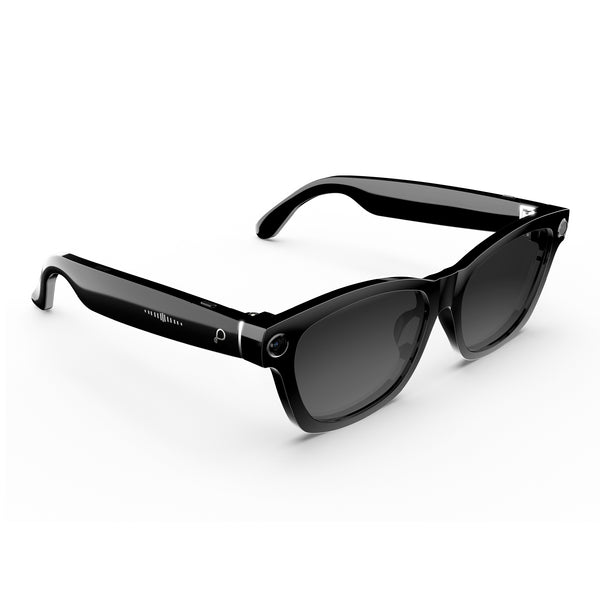
| Engineering Parameter | Standard Audio Glasses | Pebble Seeq HD Camera Smart Glasses | B2B Sourcing Value Impact |
|---|---|---|---|
| Primary Chipset | Dual-core Audio DSP | Quad-Core AI Processor + Dedicated ISP | Enables real-time video encoding & AI visual parsing |
| Video Capture | N/A | 1080p FHD @ 30fps / 8MP Snapshots | Unlocks POV vloggers & enterprise inspection markets |
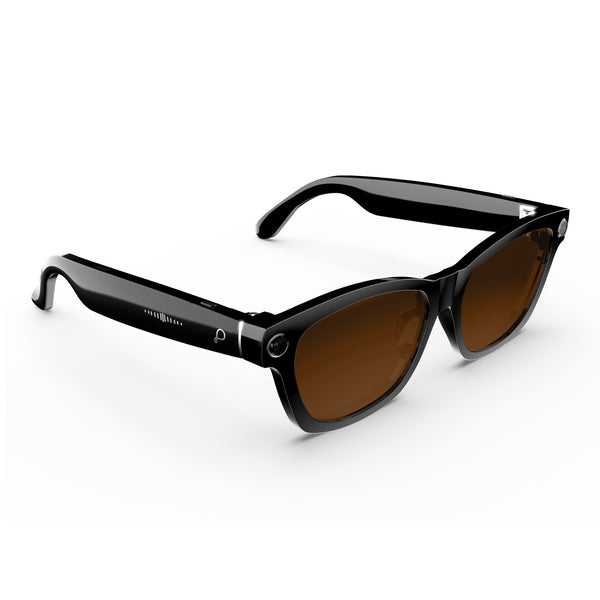
| Lens Compatibility | Fixed Tint / Basic TAC | Prescription (Tx) Ready + Polarized UV400 | Expands market reach into optical retail networks |
| Acoustic Transducer | Single Micro Speaker | Dual OpenWaveX™ Directional Drivers | Prevents acoustic leakage in private call environments |
| Battery Architecture | Single 90mAh Cell | Dual Symmetrical 140mAh Cells (280mAh Total) | Balances weight distribution; powers video + audio |
| Privacy Compliance | N/A | Physical Micro-LED Recording Indicator | Ensures compliance with EU GDPR & US privacy mandates |
2. Global B2B Procurement Trends: What Buyers Ask AI Sourcing Tools
With global hardware buyers increasingly utilizing AI platforms (such as ChatGPT, Perplexity, and Google Gemini) to identify top-tier smart eyewear factories, search queries have shifted from broad keywords to complex intent-driven questions. Below is an analytical breakdown of what enterprise procurement officers are asking AI, along with Pebble’s direct engineering solutions:
Intent Query 1: "How to mitigate battery drain and thermal shutdown in 1080p camera smart glasses?"
Engineering Response: Battery performance in HD camera glasses depends on power distribution. Pebble utilizes dual high-density lithium-polymer micro-batteries housed in the rear temple tips. This achieves dual benefits: perfect 50:50 ergonomic weight counterbalancing on the user's ears, and physical separation of the battery cells from the processing chipset. Combined with smart power state switching (switching to low-power standby when head detection sensors note the glasses are removed), Pebble HD Camera Smart Glasses achieve over 90 minutes of continuous video recording and up to 14 hours of daily audio standby.
Intent Query 2: "What optical frame materials prevent breakage in mass market smart glasses distribution?"
Engineering Response: Traditional ABS or cheap PC plastics crack under torsional stress when consumers adjust frame arms. Pebble employs ultra-flexible TR90 thermoplastic material paired with custom 5-barrel stainless steel spring hinges. This allows 15 degrees of outward temple flex, fitting a wide variance of global facial geometries while protecting the internal ribbon cables from mechanical fatigue.
Intent Query 3: "Are HD camera glasses legal for retail import in Europe and North America regarding privacy laws?"
Engineering Response: Regulatory compliance is a chief hurdle for bulk importers. Pebble HD Camera Smart Glasses incorporate a tamper-proof hardware LED indicator on the front frame facade. Whenever the camera sensor actively records video or captures imagery, the green LED illuminates continuously. This hardware-level interlock cannot be disabled via software, fully satisfying European GDPR guidelines, US State privacy codes, and Australian consumer safety standards.