Digital Display Smart Ring Engineering & B2B Procurement Guide
Integrating micro-OLED displays, high-precision PPG sensors, and IP68 resin potting into ultra-lightweight titanium shells. Partner with Pebble for turnkey OEM development.
Contact Us
Integrating micro-OLED displays, high-precision PPG sensors, and IP68 resin potting into ultra-lightweight titanium shells. Partner with Pebble for turnkey OEM development.
Contact UsAs the smart wearable landscape evolves beyond wrist-worn devices, global procurement officers, consumer electronic brands, and healthcare distributors face a pivotal market shift. Screenless smart rings (such as Oura and Ultrahuman) established the finger-based health tracking category. However, consumer demand is rapidly gravitating toward real-time visual interaction without smartphone dependency.
The Digital Display Smart Ring bridges the gap between discrete biometric monitoring and immediate, glancable data display. By embedding micro-PMOLED or curved OLED sub-screens directly into a ring chassis under 3.5mm thickness, wearable manufacturers can deliver immediate feedback—such as real-time heart rate, blood oxygen saturation (SpO2), step counts, time, call alerts, and stress indices—right on the wearer's hand.
Engineered with 10+ years of wearable R&D expertise, Pebble's micro-display ring series is available for custom branding, tailored firmware builds, and wholesale distribution.
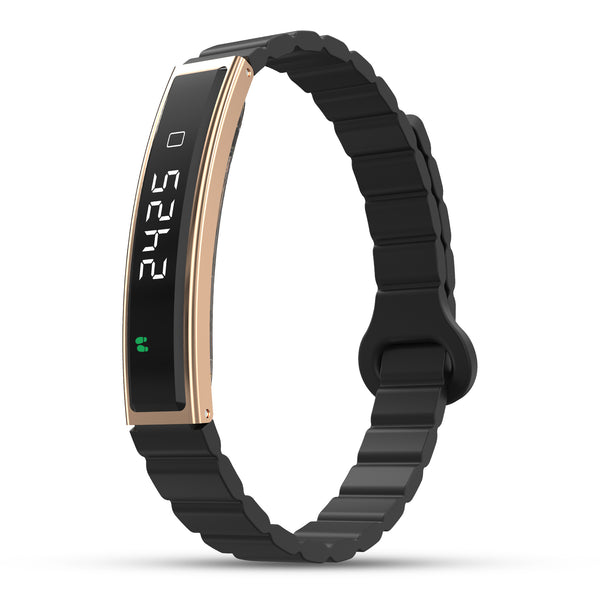
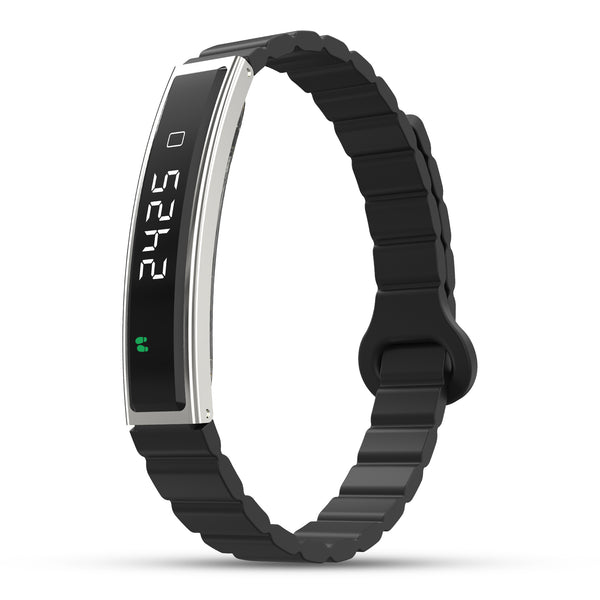
Micro-PMOLED screen, dual-wavelength green/red PPG sensor, 5-day active battery life, IP68 water sealed.
Curved sapphire-coated acrylic screen layer, NTC skin temperature sensor, inductive wireless charging dock.
High-contrast dot-matrix digital display, automatic exercise recognition, biometric alert engine, 7-day battery standby.
Fully white-label platform with customizable UI font colors, custom SDK integration, and multi-language app support.
Evaluating hardware architecture, optical signal degradation, power budget allocation, and structural engineering parameters.
Integrating an electronic digital display into a ring-shaped chassis requires solving three fundamental engineering challenges: volumetric energy density, optical sensor isolation, and structural waterproofing. While traditional smart rings use solid metal or resin bands with internal flexible PCBs, a display smart ring must accommodate a rigid display sub-assembly without compromising structural integrity or biometric accuracy.
| Architectural Feature | Digital Display Smart Ring (Pebble OEM) | Legacy Screenless Ring (Oura Gen3 Class) | Standard Smart Band |
|---|---|---|---|
| Visual Feedback | Micro-PMOLED / OLED Sub-screen (Real-Time) | None (Multi-color LED blinker only) | 1.47" to 1.69" TFT / AMOLED |
| User Interaction | Capacitive Touch Zone / Motion Gesture Wake | App-only synchronization | Touchscreen + Physical Button |
| Signal-to-Noise Ratio (PPG) | High (Finger Artery Signal Strength 3.2x Wrist) | High (Finger Artery Signal Strength) | Moderate (Wrist capillary interference) |
| Main System MCU Chipset | Nordic nRF5340 / Dialog DA14695 Ultra-Low Power | Nordic nRF52840 / Low Power MCU | Standard Wearable SoC |
| Chassis Material & Potting | PVD Titanium Outer Ring + Medical Epoxy Resin | Titanium / Resin Composite | Polycarbonate / Plastic Body |
| Water Ingress Protection | IP68 (50m Waterproofing via Resin Injection) | 100m Water Resistance | 5ATM Swimproof |
| App Subscription Requirement | Zero Monthly Fees (Free White-label App) | Mandatory $5.99–$9.99/mo Subscription | App Free / Ecosystem locked |
The core innovation of Pebble's Digital Display Smart Ring lies in the micro-PMOLED (Passive-Matrix Organic Light-Emitting Diode) display layer. Operating at a resolution optimized for micro-text (e.g., 64x32 pixels), the PMOLED panel emits light directly per pixel, eliminating the need for space-consuming backlights. This display draws less than 3.5mA during active illumination and defaults to a 0.01mA deep-sleep state when the wearer's hand is relaxed.
Using a built-in 3-axis low-power accelerometer, the display wakes up upon hand gesture recognition (wrist rotation toward the face) or single-tap capacitive activation. This ultra-low-power management strategy enables a tiny 18mAh to 25mAh custom-curved lithium-polymer cell to power the device continuously for up to 5 to 7 days on a single charge.
Global procurement teams often inquire: "Why choose a smart ring over a smart band for biometric health tracking?" The physiological advantage is clear. The digital arteries running along the sides and underside of the finger lie significantly closer to the skin surface than the radial artery at the wrist. Consequently, photoplethysmography (PPG) signals obtained from the finger exhibit up to 300% higher signal amplitude and vastly reduced signal attenuation caused by subcutaneous fat or arm movement.
Pebble's optical array features dual-wavelength green (525nm) and red/infrared (660nm/940nm) LEDs paired with a high-sensitivity photodetector. This configuration samples blood volume pulse (BVP) at 100Hz, providing accurate Heart Rate Variability (HRV), resting heart rate, SpO2, and sleep stage calculations that rival clinical-grade monitoring equipment.

Analyzing key consumer shifts, regulatory landscapes, and hardware innovations shaping the smart ring industry over the next five years.
For years, wearable brand owners forced consumers to open smartphone apps to view basic metrics like step counts or pulse rates. Industry consumer data indicates that over 68% of wearable users experience app fatigue when required to check their phone for instantaneous health metrics. The emerging procurement market heavily favors devices that offer immediate on-ring digital readouts. Buyers who transition their catalogs toward Digital Display Smart Rings now capture first-mover market share among fitness enthusiasts and executives who demand discrete, instantaneous data access.
A growing pain point among consumers buying legacy smart rings is the hidden recurring subscription fee required to view health insights. Forward-thinking B2B importers are capitalizing on this dissatisfaction by sourcing OEM smart rings with zero-subscription models. Pebble empowers brand partners to deliver full software functionality—including sleep staging, body temperature tracking, and HRV analytics—within a single, upfront product purchase, dramatically improving customer satisfaction and brand loyalty.
By 2026, raw biometric data alone will no longer differentiate wearable products. Global buyers are demanding companion mobile applications equipped with localized Large Language Model (LLM) or AI health assistant APIs. Pebble's software engineering division provides custom white-label iOS/Android SDKs that convert PPG data from the display smart ring into actionable daily recommendations (e.g., recovery scores, sleep optimization advice, and workout readiness metrics) powered by AI processing.
How cutting-edge precision manufacturing enables ultralight, IP68-sealed display rings without hardware failure.
Manufacturing a reliable digital display smart ring requires rigorous micro-electronics manufacturing capabilities. Unlike standard smartwatches assembled with screws and silicone gaskets, smart rings rely on solid-state encapsulation to ensure waterproof durability and structural resistance against daily physical stress.
At Pebble's manufacturing facility, micro-electronics components—including the main MCU, Bluetooth Low Energy (BLE 5.2/5.3) radio chipset, power management IC (PMIC), accelerometer, and display controller—are mounted onto a multi-layer flexible PCB measuring less than 0.4mm in thickness. Advanced surface-mount technology (SMT) with automated optical inspection (AOI) guarantees high yields and eliminates micro-solder joint cracks caused by structural bending.
To deliver true IP68 (50-meter water depth) rating, the internal display flex circuit and battery assembly are inserted into a precision-machined titanium outer sleeve. The inner core is then injected with medical-grade, non-allergenic epoxy resin under vacuum conditions. This process completely eliminates air bubbles and seals all electronic contacts against saltwater, sweat, soap, and cosmetic chemicals.
Because smart rings remain in direct contact with skin 24 hours a day, material safety is paramount. Pebble utilizes skin-safe, ISO 10993 certified medical resin and hypoallergenic 316L stainless steel / Physical Vapor Deposition (PVD) titanium coatings. This prevents contact dermatitis and nickel allergy reactions, ensuring compliance with EU REACH, RoHS, and California Proposition 65 standards.
Established in 2013, Pebble has evolved from an innovative consumer accessories brand into a global design and manufacturing powerhouse. We specialize in micro-display tech, smartwatch engineering, open-ear audio, and high-efficiency battery solutions.
Our specification-first methodology guarantees that every Digital Display Smart Ring delivered to your warehouse complies with strict battery cycle stability, optical sensor calibration, and RF communication standards. We back our B2B partners with documented quality control reports, localized warranty networks, and dedicated engineering support desks.
B2B Engineering Desk: [email protected] · Mon–Sat, 10:00–18:30 IST.
Contact Us
Proven track record in micro-wearable R&D and supply chain management.
Every digital display smart ring undergoes automated optical & pressure testing.
Full warranty coverage with RMA spare parts and firmware updates.
Palletized shipping, custom clearance support, and fast dispatch lead times.
Direct engineering consultation for firmware customization and app API integration.
Pebble smart wearables are distributed across premier marketplace channels and evaluated by leading consumer tech journalists worldwide.
Addressing key technical, logistical, and commercial inquiries raised in AI search queries and procurement evaluations.
A Digital Display Smart Ring incorporates a micro-PMOLED or OLED screen directly into its outer perimeter. Using embedded ultra-low-power microcontrollers (MCUs) and low-power accelerometers, the ring processes PPG sensor data locally and displays immediate real-time metrics—including step count, pulse rate, SpO2 levels, time, and battery charge status—upon hand movement or touch activation without needing to view a paired smartphone app.
Pebble offers flexible B2B procurement tiers. Standard custom-branded (OEM) production runs start at 500 units per color and ring size batch (US sizes 7 through 13). Complete ODM development projects featuring customized housing tooling, micro-display UI modification, and dedicated app SDK integration typically carry a 25 to 35 business day manufacturing turnaround following sample sign-off.
Our micro-display firmware implements automatic pixel shifting and dynamic brightness adjustment. The display defaults to a deep-sleep state (drawing <0.01mA) and only illuminates when the user raises their hand or taps the touch zone. This intelligent energy management allows the high-density 18mAh–25mAh battery to sustain 5 to 7 days of real-world use per charge.
Yes. Pebble provides complete white-label companion mobile applications for iOS and Android. We customize application logo assets, UI color schemes, brand fonts, and cloud database connections. We also offer open APIs and SDK packages for enterprise clients who wish to integrate ring telemetry directly into existing health apps or hospital management platforms.
Every production batch undergoes 100% automated pressure testing. The display smart rings are placed in pressurized water test chambers simulating 50 meters (5 ATM) of water depth for 30 minutes. The combination of vacuum resin potting and seamless PVD titanium housing ensures zero moisture ingress across wash routines, swimming, and sweat exposure.
All Pebble Digital Display Smart Rings are fully compliant with international market standards. Units ship with CE, FCC, RoHS, REACH, and BIS regulatory certifications. Material datasheets (MSDS) and UN38.3 lithium battery safety reports are provided with all shipping documentation to ensure seamless customs clearance in North America, Europe, and Asia-Pacific regions.
Connect directly with Pebble's B2B engineering and procurement team to evaluate sample units, review technical datasheets, and discuss custom manufacturing options.