
China’s Fitness Health Smart Band industry has moved beyond simple step counting. Today’s devices track heart rate, sleep patterns, blood oxygen, workouts, and daily recovery signals. Small screens now support large health decisions.
IDC’s Worldwide Quarterly Wearable Device Tracker reported approximately 520.5 million wearable devices shipped globally in 2023. Wrist-worn products remained important within this broad category. Counterpoint Research also identifies China as a major manufacturing and consumption center for smart wearables. These figures show strong demand, but they do not prove that every brand offers equal quality.
This guide examines China’s top 10 Fitness Health Smart Band manufacturers through practical and technical criteria. The review considers sensor performance, battery endurance, app stability, production capacity, customization services, and export experience. It also examines compliance documentation, including relevant CE, FCC, RoHS, and quality-management practices where applicable. Certification details should always be verified with the manufacturer.
The World Health Organization reported that about 31% of adults worldwide were insufficiently physically active in 2022. That gap creates opportunities for accessible activity-monitoring devices. A band on a commuter’s wrist may encourage a short evening walk. However, wearable readings are not medical diagnoses.
No ranking is perfect. Supplier capabilities can change quickly. Some public claims also need closer verification. Therefore, this selection combines industry evidence, manufacturer information, and realistic buyer concerns. It is designed for importers, distributors, fitness brands, and technology companies seeking dependable Chinese partners. Each candidate deserves independent testing before a long-term order.
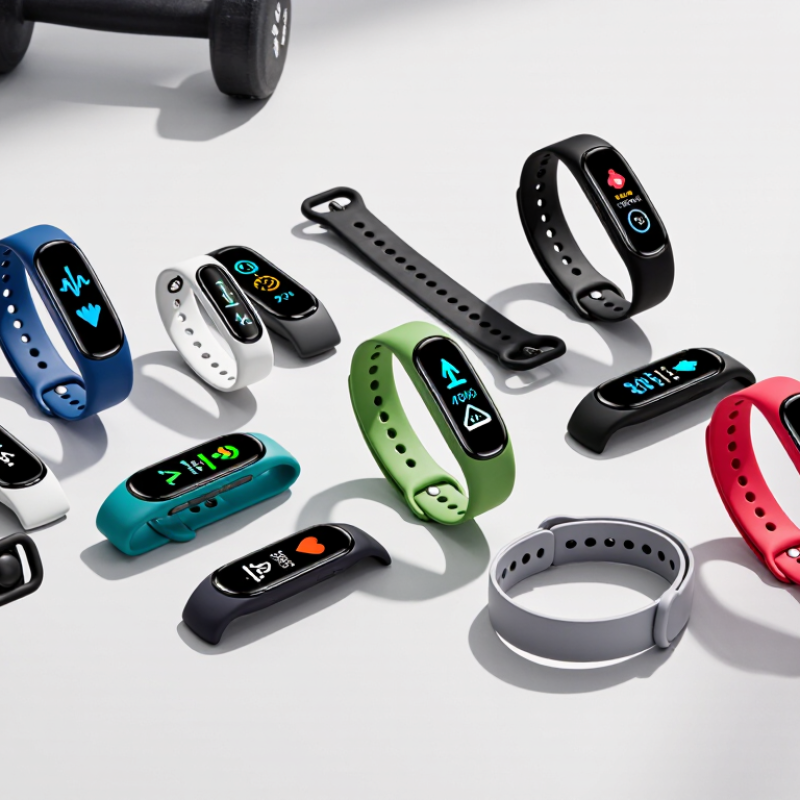
Fitness health smart bands are compact wearable devices that track daily movement and selected body signals. They usually combine optical sensors, motion sensors, and Bluetooth connectivity. A small green light measures blood flow near the skin. This process estimates heart rate during rest, walking, or exercise.
An accelerometer detects steps, posture, and sudden movement. Some models also use gyroscopes for better activity recognition. Their software compares sensor patterns with user data. It then estimates calories, sleep stages, stress levels, or workout intensity. These results can guide healthier routines, but they are not medical diagnoses. The numbers are useful, not perfect. Skin tone, loose straps, movement, sweat, and poor contact can affect readings. Sleep estimates especially need cautious interpretation.
Tips: Wear the band firmly above the wrist bone, but keep it comfortable. Clean the sensor after exercise. Keep your arm still during resting heart-rate checks. Compare trends across several days instead of trusting one unusual result. A reading that seems wrong deserves reflection, not panic. For persistent symptoms, consult a qualified healthcare professional. Also review privacy settings before syncing health data, because convenience should not replace informed control.
China’s fitness health smart band manufacturing landscape is shaped by dense supply chains, skilled electronics labor, and rapid product iteration. In the top ten manufacturer selection, buyers should examine more than production capacity. They need evidence of sensor calibration, battery testing, water resistance checks, and traceable quality records. A polished sample proves little.
Manufacturers commonly support OEM and ODM development. Their facilities may combine wristband molding, circuit assembly, firmware testing, and packaging within one regional network. This structure can shorten development cycles and reduce shipping delays. Typical health features include heart-rate tracking, sleep monitoring, blood oxygen estimates, and activity measurement. These readings are useful for wellness awareness, but they are not medical diagnoses. Testing must reflect real use, including loose straps, sweat, skin movement, and repeated charging.
Compliance deserves equal attention. Reliable suppliers can explain material safety, radio requirements, privacy controls, and market-specific documentation. They should also describe how user data is stored, transferred, and deleted. Factory visits, sample inspections, and independent laboratory reports provide stronger evidence than brochures. Still, the landscape is not flawless. Some suppliers prioritize appearance and low pricing over long-term sensor stability. Firmware updates may receive less attention after shipment. That gap matters. A responsible sourcing process should compare failure rates, warranty handling, update policies, and production consistency across several batches. Small details often decide whether a smart band performs reliably beyond the showroom.
| Rank | Manufacturer Profile | Major Production Cluster | Core Product Focus | Typical Health Features | Common Protection Rating | OEM / ODM Capability | Typical Certifications | Primary Export Markets | Typical Development Lead Time |
|---|---|---|---|---|---|---|---|---|---|
| 1 | Profile A Large-scale integrated supplier |
Shenzhen and Dongguan, Guangdong | Fitness bands Connected wearables | Heart-rate monitoring, blood-oxygen estimation, sleep tracking, step counting, calorie estimation, multi-sport modes | IP68 or 5 ATM on selected models | Yes | CE, FCC, RoHS, REACH, UN38.3 for applicable battery shipments | Europe, North America, Southeast Asia, Middle East | 8–14 weeks for a new customized model |
| 2 | Profile B Bluetooth wearable specialist |
Shenzhen, Guangdong | Bluetooth smart bands Companion-app devices | Optical heart-rate sensor, blood-oxygen estimation, sedentary reminders, sleep stages, activity tracking | IP67 or IP68 | Yes | CE, FCC, RoHS, UKCA for applicable markets | Europe, Latin America, South Asia, Africa | 6–12 weeks for platform-based customization |
| 3 | Profile C Health-monitoring focused supplier |
Shenzhen and Huizhou, Guangdong | Health bands Wellness monitoring devices | Heart-rate trends, blood-oxygen estimation, respiratory-rate estimation, sleep monitoring, stress indicators | IP68 on mainstream models | Yes | CE, FCC, RoHS, ISO 9001 manufacturing systems | Europe, North America, Gulf countries, Australia | 10–16 weeks for sensor and software modifications |
| 4 | Profile D Cost-efficient volume manufacturer |
Shenzhen and Dongguan, Guangdong | Entry-level fitness bands Private-label products | Step counting, heart-rate monitoring, sleep duration, calories, distance, basic sports tracking | IP67 or IP68 | Yes | CE, FCC, RoHS; market-specific documentation available | Latin America, Africa, Southeast Asia, Eastern Europe | 4–8 weeks using an existing platform |
| 5 | Profile E Industrial design and customization supplier |
Shenzhen, Guangdong | Custom-housing bands Corporate wellness devices | Heart-rate monitoring, sleep analysis, activity goals, sports modes, notification management | IP68 or 5 ATM depending on enclosure design | Yes | CE, FCC, RoHS, REACH, ISO 9001 | North America, Europe, Japan, South Korea | 10–18 weeks for mechanical redesign |
| 6 | Profile F App and firmware integration supplier |
Shenzhen and Guangzhou, Guangdong | App-connected bands Data-platform solutions | Heart-rate monitoring, blood-oxygen estimation, sleep tracking, exercise records, cloud synchronization | IP67 or IP68 | Yes | CE, FCC, RoHS, Bluetooth qualification where applicable | Europe, North America, Southeast Asia, Middle East | 8–16 weeks for software integration |
| 7 | Profile G Sports-performance wearable supplier |
Dongguan and Shenzhen, Guangdong | Sports bands Outdoor activity trackers | Multi-sport tracking, heart-rate zones, GPS connection, workout duration, calories, recovery indicators | 5 ATM or IP68 on selected product lines | Yes | CE, FCC, RoHS, UN38.3 for lithium-battery logistics | Europe, North America, Australia, South Korea | 10–20 weeks for sports-feature customization |
| 8 | Profile H Flexible low-MOQ ODM supplier |
Shenzhen and Zhongshan, Guangdong | Small-batch ODM Promotional fitness bands | Steps, calories, sleep duration, heart-rate monitoring, reminders, basic notification functions | IP67 or IP68 | Yes | CE, FCC, RoHS; factory quality documentation available | Latin America, Africa, Southeast Asia, Europe | 3–7 weeks for existing designs |
| 9 | Profile I Premium materials and finishing supplier |
Shenzhen and Huizhou, Guangdong | Premium fitness bands Metal and ceramic finishes | Heart-rate monitoring, blood-oxygen estimation, sleep stages, stress tracking, guided breathing, sports modes | 5 ATM or IP68 | Yes | CE, FCC, RoHS, REACH, ISO 9001 | Europe, North America, Japan, Australia | 12–20 weeks for materials and tooling changes |
| 10 | Profile J High-mix export manufacturing supplier |
Shenzhen, Dongguan and Jiangsu | Multi-model production International private label | Heart-rate monitoring, blood-oxygen estimation, sleep tracking, step counting, sports modes, sedentary alerts | IP67, IP68 or 5 ATM by model | Yes | CE, FCC, RoHS, UKCA, RCM or other destination-market requirements | Europe, North America, Middle East, Southeast Asia | 6–14 weeks for standard customization |
Selecting China’s top ten fitness health smart band manufacturers requires more than comparing product photos or factory claims. Start with verifiable production experience, engineering staff, monthly capacity, and previous export projects. Request sample units from the same production line. Check sensor consistency, step-count accuracy, heart-rate readings, screen visibility, charging contacts, and battery performance over several days. Small details matter.
Technical competence should be tested, not assumed. Request reports for electrical safety, radio compliance, skin-contact materials, and battery requirements in the target market. Review each laboratory and report date. A serious manufacturer explains firmware updates, app security, data handling, and vulnerability response clearly. It should provide traceable quality records, material inspections, aging tests, and defect-rate data. Numbers without evidence are weak.
Commercial reliability separates a capable factory from a convenient supplier. Score prototype speed, minimum order quantities, tooling fees, packaging control, lead-time accuracy, and spare-part support. Speak with recent customers where possible, then verify references independently. Arrange a facility visit or live video audit showing assembly, calibration, and final inspection. No checklist is perfect. I would keep a risk score for quality, compliance, communication, and supply continuity, while allowing room for judgment. A low quote may conceal rushed testing or unstable components, so value should be measured across the product’s full service life, not only at purchase.
China Top 10 Fitness Health Smart Band Manufacturers
Profiles of China’s Top 10 Fitness Health Smart Band Manufacturers
This profile examines ten leading Chinese manufacturers of fitness health smart bands. Each company is assessed through product engineering, factory capability, quality control, and export experience. Their products commonly track steps, heart rate, sleep patterns, blood oxygen estimates, and workout activity. Feature depth varies widely.
Several manufacturers specialize in compact, lightweight bands for daily wear. Others focus on rugged housings, brighter displays, or longer battery performance. In production facilities, teams often test charging ports, wrist sensors, waterproof seals, and Bluetooth stability. A reliable supplier should provide traceable materials, inspection records, and clear technical specifications. Claims about health data also require careful wording and responsible validation.
The profiles reveal different strengths. One manufacturer may offer flexible software integration, while another performs better in large-volume assembly. Some maintain strong sampling procedures, yet their packaging or application design may feel dated. That matters to buyers. Product quality is not only about sensor accuracy. It also includes comfort after eight hours, readable numbers under sunlight, and stable use during exercise. No manufacturer is flawless. Even experienced teams can face calibration gaps, delayed components, or inconsistent samples. Buyers should request pilot orders, review test reports, and compare production samples before signing a larger agreement.
An anonymized comparison of commonly documented product and service capabilities across ten leading Chinese fitness health smart band manufacturers.
The chart counts manufacturers associated with each capability in public product and supplier profiles. Company names and brand-specific sales data are intentionally excluded.
China’s top ten fitness smart band manufacturers should be compared through evidence, not catalog photos. IDC reported 534.2 million wearable device shipments worldwide in 2024, up 9.9% year over year. This growth increases buyer pressure on sensor accuracy, battery life, and software stability. Optical heart-rate tracking, sleep analysis, GPS connection, and water resistance remain core features. However, IP68 does not automatically mean safe for swimming.
Quality needs practical testing. Check heart-rate readings during walking, interval training, and uneven movement. Request battery-cycle records, app crash rates, and sample inspection reports. ISO 9001 systems help, but they cannot replace factory audits. One weakness remains common: suppliers may provide excellent samples, then change components after order confirmation. That risk deserves written controls.
Pricing varies with display type, sensor count, tooling, and order volume. Basic bands often compete near the low-cost segment, while AMOLED screens and independent positioning raise costs sharply. Counterpoint Research has identified continued demand for affordable wearables, especially in emerging markets. Export capability should include CE, FCC, RoHS, battery transport documents, multilingual apps, and stable firmware updates. Delivery performance matters too; ask for historical on-time shipment data. I would also compare warranty returns by market, not only the lowest unit price. The cheapest quotation can become expensive.
Review sensor calibration, battery testing, water resistance checks, and traceable quality records. Production capacity alone proves little.
Many suppliers offer OEM and ODM services. They may support molding, circuit assembly, firmware testing, and packaging.
Typical features include heart-rate tracking, sleep monitoring, blood oxygen estimates, and activity measurement. These readings support wellness awareness, not medical diagnosis.
Testing should include loose straps, sweat, skin movement, and repeated charging. A desk test is not enough.
Request material records, inspection reports, and technical specifications. Check charging ports, wrist sensors, waterproof seals, and Bluetooth stability.
Samples can look consistent while later batches vary. Compare sensor performance, appearance, packaging, and failure rates across shipments.
Ask how firmware updates are handled after shipment. Also ask how user data is stored, transferred, and deleted.
Yes, they provide stronger evidence than brochures. Still, reports may not reveal every long-term weakness.
Check comfort after eight hours, screen readability under sunlight, and stability during exercise. Small details matter.
A pilot order can reveal calibration gaps, delayed components, and inconsistent samples. It costs time, but skipping it may cost more.
This article provides a practical overview of the Fitness Health Smart Band industry in China, explaining how these wearable devices monitor activity, heart rate, sleep, exercise performance, and other wellness indicators through sensors and connected mobile applications. It also examines China’s manufacturing landscape, including the roles of product design, component sourcing, software development, assembly, testing, and international logistics in creating reliable smart wearable products.
To identify the top ten Chinese manufacturers, the article evaluates factors such as technical capability, product quality, customization options, certifications, production capacity, pricing, communication, and export experience. Each manufacturer profile focuses on its strengths without relying on brand promotion, helping readers understand differences in development expertise and supply-chain support. The final comparison considers features, durability, service, cost efficiency, and overseas delivery capabilities, offering buyers a clear framework for selecting a suitable manufacturing partner.