
Choosing a Women's Luxe Smartwatch is not simply a search for polished metal and a famous logo. It is a practical decision involving comfort, health features, privacy, battery life, and long-term value. A watch may look stunning beneath boutique lighting, yet feel heavy after six hours at a desk. The right choice should fit real routines, from morning commutes to evening events. This guide introduces seven useful tips for evaluating luxury smartwatches with a clear, informed eye.
Experienced buyers often start with the wrist, not the advertisement. Measure the case, inspect the clasp, and consider whether the strap irritates sensitive skin. Check display brightness outdoors, notification controls, app compatibility, charging time, and repair support. Health tracking can be helpful, but it is not a medical diagnosis. Manufacturer claims deserve comparison with independent reviews and warranty terms. Small details matter. A beautiful sapphire screen means little if the battery cannot last through a busy day.
The following tips balance design judgment with technical evidence and everyday experience. They encourage readers to compare materials, sensors, software updates, security practices, and total ownership costs. Some preferences remain personal, and no guide can predict every wrist or lifestyle. I may value discreet notifications, while another buyer prioritizes precise fitness data. That uncertainty is worth admitting. Careful research, hands-on testing, and honest expectations can make a Women's Luxe Smartwatch feel like a useful companion rather than an expensive accessory.
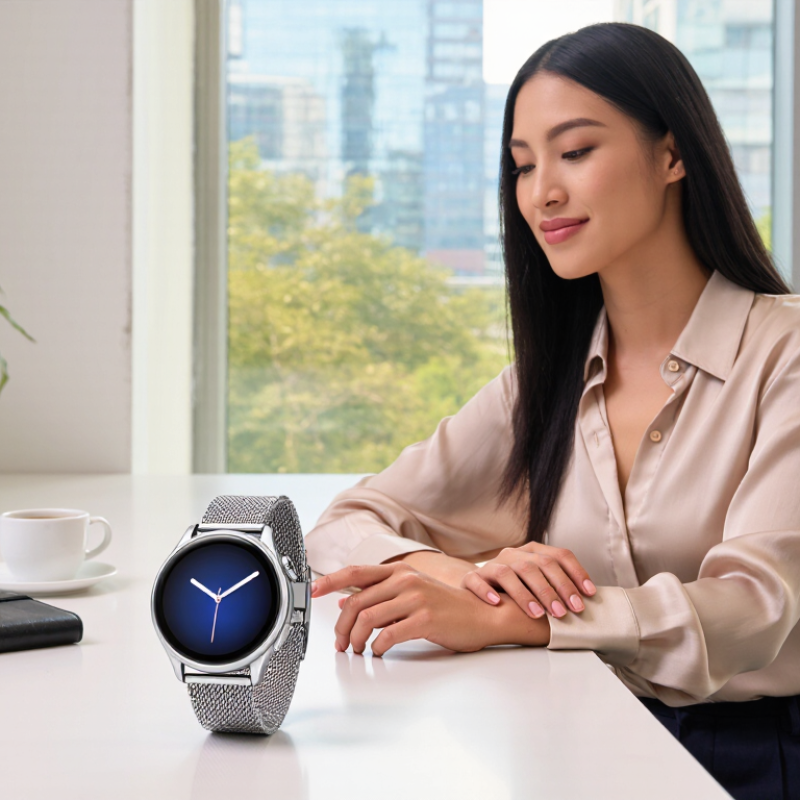
7 Tips for Buying a Women’s Luxe Smartwatch
Understanding what defines a women’s luxe smartwatch starts with fit, not decoration. A refined model should sit securely on a smaller wrist without pinching during sleep. Measure your wrist before shopping. Then check case thickness, lug length, strap flexibility, and clasp quality. Luxury also means thoughtful materials, readable glass, balanced weight, and a screen that remains visible outdoors. Pink details are optional. Comfort is not.
Grand View Research valued the global smartwatch market at about $33.6 billion in 2023. Its report also forecasts strong growth through 2030. That expansion makes specifications harder to compare. Look beyond appearance. A useful watch should offer dependable heart-rate tracking, sleep monitoring, water resistance, and clear health explanations. The World Health Organization warns that consumer health devices should not replace professional diagnosis. That limitation matters.
Battery life affects luxury more than many buyers expect. A beautiful watch becomes frustrating when charging interrupts travel or sleep tracking. Check real-world battery claims, not only laboratory figures. Review software-update policies, data controls, repair options, and long-term strap availability. The International Data Corporation’s wearable-device research shows sustained consumer demand, but popularity does not guarantee quality. I once focused too heavily on polished metal. The lighter, better-fitting option proved easier to wear. That was an imperfect lesson. A luxe smartwatch should feel quietly useful, personally suitable, and trustworthy after the first impression fades.
Use these practical benchmarks to compare elegance, comfort, durability, smart functions, and long-term value.
| Tip | Buying Dimension | What to Look For | Useful Benchmark | Why It Matters |
|---|---|---|---|---|
| 1 | Choose a refined case size | Compare the case diameter, thickness, lug shape, and total weight against the wearer’s wrist. | Approximately 36–42 mm for a balanced, jewelry-inspired appearance; under about 12 mm thick for easier cuff and sleeve comfort. | A smaller or slimmer profile can look more proportionate on a narrow wrist, while a larger display may improve readability. |
| 2 | Prioritize premium materials | Assess the case metal, crystal, backplate, buttons, and strap or bracelet finishing. | Look for stainless steel or other durable metal cases, sapphire crystal for stronger scratch resistance, and skin-friendly strap materials. | Material quality affects appearance, daily comfort, resistance to wear, and how well the watch transitions from casual to formal settings. |
| 3 | Check water and dust resistance | Confirm the stated IP rating or ATM water-resistance rating and read the manufacturer’s limitations. | IP68 commonly indicates dust-tight protection and resistance to continuous immersion under specified test conditions; 5 ATM is generally rated for swimming, subject to product instructions. | Ratings are not identical across products. Avoid assuming that water resistance means suitability for diving, hot tubs, or high-pressure water. |
| 4 | Evaluate battery practicality | Compare typical battery life, charging method, charging time, and whether always-on display or GPS reduces endurance. | A practical target is at least 2–3 days of typical use, with a clearly specified fast-charge or standard-charge time. | Longer endurance reduces charging interruptions, while a convenient magnetic or wireless charger improves everyday usability. |
| 5 | Match health features to real needs | Review heart-rate tracking, sleep monitoring, activity tracking, cycle-related logging, and workout modes. | Choose sensors and functions that operate continuously or automatically when needed, and verify whether advanced features require a compatible phone or subscription. | Consumer wearables can support wellness awareness but are not substitutes for professional medical diagnosis or treatment. |
| 6 | Inspect display and smart functions | Consider display brightness, resolution, touch responsiveness, notification controls, calling support, payments, and phone compatibility. | An AMOLED or OLED display generally provides strong contrast; automatic brightness and a minimum brightness of around 1,000 nits can improve outdoor visibility. | A polished smartwatch should be easy to read and discreet to operate without compromising privacy or requiring constant phone access. |
| 7 | Assess comfort, customization, and value | Try the clasp, examine strap adjustability, confirm replacement-strap availability, and review software-support expectations. | Prefer tool-free or widely available strap changes, secure closures, multi-day comfort, and a clearly stated warranty of at least 12 months. | Luxury value is more than appearance: dependable support, repair options, comfortable wear, and long-term software compatibility protect the purchase. |
Measure your wrist and try cases around 36 to 40 millimeters. A long sleeve can reveal pressure points. Comfort matters more than fashion rules.
Match the watch face with your usual clothing. A minimal face suits formal outfits, while softer shapes feel relaxed. Interchangeable straps add flexibility, but changing them can become tedious.
Stainless steel feels durable and substantial. Ceramic looks refined but may chip after impact. Leather feels warm, yet moisture can shorten its life. I once chose a pale strap that marked quickly.
Test notifications, voice replies, navigation, calendar access, and fitness tracking. A beautiful case cannot repair weak software. Check how messages appear on the actual screen.
No. They can show patterns in heart rate, sleep, oxygen readings, and workouts. They do not provide medical diagnoses. Use the data as guidance, not certainty.
Read independent testing and sensor explanations. Compare readings during walking, stairs, and quiet sleep. Marketing claims are not enough. Some results may still vary.
Check charging time and battery life with health tracking enabled. Nightly charging may erase sleep data. Battery performance often disappoints when many features run together.
Ask about battery coverage, repair time, shipping, and replacement-part availability. Get the terms in writing. A polished sales conversation is not a service plan.
No. Inspect the clasp, crown, case joins, sensors, and strap fit. Compare software-update commitments and later battery costs. Resale prices are uncertain, sometimes very uncertain.
Choosing a Women's Luxe Smartwatch means balancing refined design with practical features. Start by considering what makes a smartwatch feel luxurious to you, then look for a style, size, and material that suit your wardrobe, wrist, and daily routine. Compare the smart features and health tools you are likely to use, and make sure the watch works smoothly with your phone and other devices.
Before making a decision, assess battery life, durability, and comfort for all-day wear. Details such as a clear display, secure fit, and materials that feel good against your skin can make a noticeable difference over time. Finally, review the craftsmanship, warranty coverage, and expected long-term value. A thoughtful choice should look elegant while remaining comfortable, dependable, and useful well beyond the initial purchase.