
Choosing the best Open Ear OWS Earbuds manufacturer in China takes more than comparing prices or polished product photos. Open-Ear OWS Earbuds must balance clear sound, stable fit, comfortable pressure, and awareness of nearby sounds. Small design choices matter. A stiff ear hook can irritate after an hour, while a weak microphone can make outdoor calls frustrating.
Industry figures offer context, but they need careful reading. The Bluetooth SIG’s 2024 Market Update forecasts annual Bluetooth device shipments reaching 7.5 billion by 2028. That figure covers many product categories; it is not a forecast for open-ear earbuds alone. It does, however, show why Bluetooth performance, efficient power use, and dependable connection testing deserve attention. Market growth does not prove that every supplier can deliver consistent quality.
A serious manufacturer should explain its process in concrete terms: acoustic tuning, prototype revisions, battery testing, water-resistance checks, and production quality controls. Ask how it handles firmware updates, component changes, and defects found during a production run. Request samples, test reports, and clear explanations of minimum order quantities and lead times. Look closely. A persuasive sales presentation cannot replace repeatable testing. No single factory is best for every brand, and supplier claims should be verified against samples and documented results. The right partner is the one that can match your product requirements, communicate limitations honestly, and maintain quality from prototype to shipment. There is room for doubt. That is useful, not a weakness.
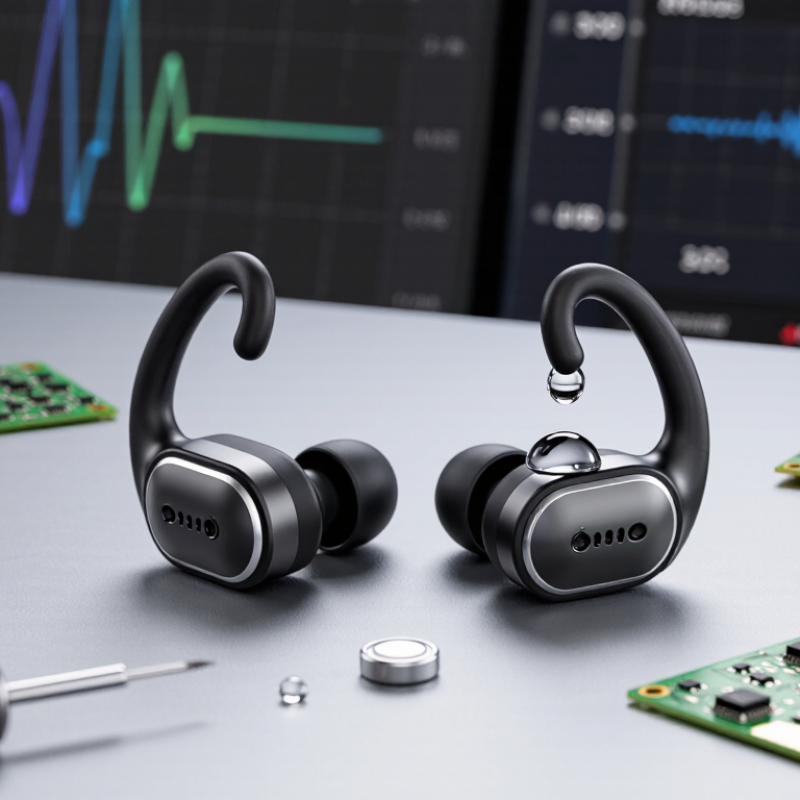
Open-ear OWS earbuds sit outside the ear canal rather than sealing it. Their small speakers direct sound toward the ear, using air as the listening path. This air-conduction design leaves the canal uncovered, which can feel cooler during a walk or a long work call. You may still hear nearby voices, traffic, or a doorbell. That awareness is useful, but it does not make listening risk-free in every setting.
A secure fit matters. The speaker position should stay steady when you turn your head, while the frame should avoid pressing hard behind the ear. Open designs can sound less powerful in noisy places, and nearby people may hear some audio at higher volumes. That trade-off is easy to overlook. Fit, volume, and sound quality also vary with ear shape, so a short wear test can reveal more than a spec sheet.
Tips: Check comfort after 20 minutes, not just in the first minute. Try a spoken podcast at a moderate volume, then walk in a quiet area. If the earbuds shift or cause pressure, adjust the fit before judging them.
| Evaluation dimension | What defines the design | Practical data to request | Why it matters |
|---|---|---|---|
| Air-conduction audio | Small speakers direct sound through the air toward the ear; the ear canal is generally left uncovered. | Driver type and size, frequency response, sensitivity, and test conditions. | Distinguishes open-ear earbuds from bone-conduction products, which transmit vibration through contact with the head. |
| Open-ear fit | An ear hook, clip, or similar support positions the speaker near the ear without forming an in-ear seal. | Fit samples, wearing-position guidance, product weight, and compatibility testing across ear shapes. | Fit affects comfort, stability, and how consistently sound reaches the listener. |
| Ambient awareness | Because the ear is not sealed, surrounding sounds can remain more audible than with sealed in-ear designs. | Listening tests in quiet and noisy environments; clear user guidance on safe use. | Open-ear listening does not block all noise and should not be presented as hearing protection. |
| Sound leakage | Some sound may be audible to people nearby, particularly at higher playback levels; results vary with fit and environment. | Leakage measurements at stated distances and playback levels, with repeatable test conditions. | Useful for judging suitability in shared offices, public transport, and other quiet spaces. |
| Microphone and calls | Call performance depends on microphone placement, voice processing, and the level of background noise. | Voice samples and call tests in quiet and noisy settings; microphone configuration and supported processing features. | Specifications alone do not establish real-world call clarity. |
| Wireless performance | Bluetooth provides the wireless link; supported profiles, codecs, and features depend on the product and connected device. | Bluetooth version and profiles, codec support, connection behavior, and compatibility test results. | Helps assess device compatibility, call support, and expected wireless functionality. |
| Battery and charging | Runtime varies with volume, connection conditions, call use, and battery condition; a charging case may provide additional charges. | Playback-test conditions, earbud and case battery capacity, charging time, and cycle-test method. | Comparable test conditions make battery claims more meaningful. |
| Water and dust resistance | Protection claims should be tied to a stated ingress-protection rating and the applicable test conditions. | Test report for the claimed IP rating; clarify whether the rating applies to earbuds, case, or both. | An IP rating describes defined test protection, not universal resistance to every exposure or use condition. |
| Manufacturing quality | Consistent assembly, acoustic tuning, battery handling, and documented inspection are important for repeatable production. | Quality-control plan, sample inspection records, reliability-test methods, and defect-handling process. | These records help evaluate production consistency without relying on unsupported marketing claims. |
| Compliance and documentation | Requirements depend on the destination market and product configuration. | Applicable test reports, declarations, labeling details, and supporting technical documentation for the target market. | Verify the documents and requirements relevant to the intended sales region; do not assume one certificate covers every market. |
No. It uses the 2.4 GHz band, which is also shared by Wi-Fi routers and other devices.
Yes. Crowded wireless signals may cause brief interruptions or slower reconnection. Not always.
No. Results depend on the earbuds, phone, firmware, and antenna placement.
They can test near a router, in a crowded station, and with a phone inside a pocket. Walking several metres away can reveal dropouts.
Yes. Nearby traffic or conversation may sound like an audio problem, even when the wireless link is stable.
Technicians can check cell voltage, capacity, and visible damage by batch. They also test charging behavior and protection circuits.
Checks can compare frequency response, left-right balance, microphone performance, and sound leakage. Ear-hook angle matters; a small shift may change perceived bass.
Teams can inspect adhesive placement, cable routing, screw torque, and housing alignment. Final checks may include charging and button response.
No. Sampling can miss weak cells, and rushed rework may create hidden variation. Traceable records help teams investigate later.
Open-Ear OWS Earbuds use an air-conduction design that rests outside the ear canal, allowing users to hear surrounding sounds while listening. Their performance depends on a balanced fit, clear audio, stable Bluetooth 5.3 connectivity, and thoughtful management of the shared 2.4 GHz band, where nearby wireless devices can affect signal reliability. For everyday use, water resistance is also an important consideration: an IEC 60529 IPX4 assessment involves exposure to splashing water, with a commonly specified test flow of 10 L/min for five minutes under the applicable test setup.
Reliable production requires consistent checks across battery performance, acoustic output, component sourcing, and assembly. When comparing Chinese OEM/ODM suppliers, buyers can review quality-management practices aligned with ISO 9001:2015, request evidence of production capacity, and assess inspection and testing procedures. These steps help determine whether a supplier can deliver dependable products and support development requirements from prototype through volume production.